Suche
Suche
The facade as a bridge in the cityscape
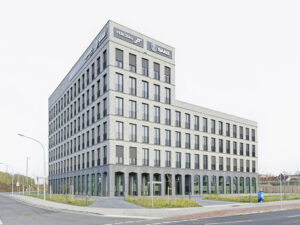
On the former Neustadt freight station in Bremen, the first built building, the six-story “Spurwerk”, marks the start of this transformation and gives the district a defining identity.

The facade as a bridge in the cityscape
Spurwerk Bremen is more than just an architectural project – it is a statement for the change in urban spaces. As the first building block of the new district, the building ensemble acts as a gateway to the newly emerging urban landscape. The use of 680 square meters of three-dimensional form parts from Rieder plays a key role. The connection between past and future becomes visible not only conceptually but also materially: a dynamic facade structure made of fiberglass concrete meets a traditional brick wall, which subtly picks up on the industrial past of the location.
© Rieder
Facade design with a special expression
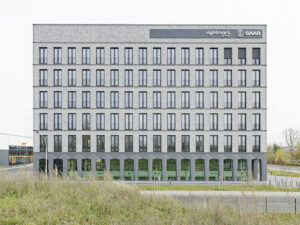
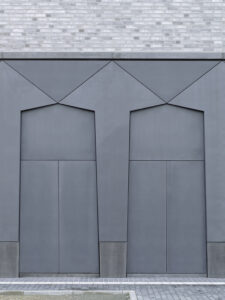
The ground floor zone is characterized by three-dimensional elements made of fiberglass concrete, which create a high recognition value thanks to their striking design language. The molded parts from Rieder used give the building a monolithic expression and support the three-dimensional effect of the architecture. The arrow shape of the vertical structuring elements reinforces the dynamics of the building and creates identity. At the same time, the three-dimensional structure creates a subtle depth that emphasizes the interplay of light and shadow. A central concern of the design was to make the area accessible to the public and to weave it into its surroundings. The facade design supports this concept through targeted transparency: open structures on the ground floor ensure permeability and accommodate the movements of passers-by.
© Rieder
Sustainable concrete solutions
In addition to the design quality of the materials, sustainable aspects also play an important role in the DGNB Gold certified project. Rieder relies on longevity and resource conservation with its facade solutions. The molded parts impress with their high resistance, their low maintenance requirements and their material-efficient production. The dimensionally stable, thin-walled concrete elements minimize the use of materials and at the same time enable an aesthetically high-quality design of the building envelope. Thanks to their robustness and repairability, the components help extend building life cycles. The Spurwerk thus received an external structure that meets today's architectural requirements and is at the same time designed for a sustainable future.
© Rieder
Precision in concrete
With its formparts, Rieder delivers a solution that combines both design and functional qualities - and thus has a lasting impact on the architecture of tomorrow. Flexible formats, individual lengths and widths as well as a wide selection of colors and surfaces open up a wide range of design options. In the Spurwerk project, formparts in anthracite with a matt surface were used, whereby special challenges had to be overcome. The large-format modules with a sash width of 2,500 millimeters required special transport solutions. In addition, the complex geometry of the triangular, forward-sloping elements placed high demands on planning and execution. Rieder developed an innovative substructure that enabled concealed installation without subsequent securing and adjusting screws - a crucial solution since it was not possible to reach behind the components. To make assembly easier, the suspension was optimized so that a standardized substructure designed for flat facades could be used. The entire planning was done in 3D, including detailed assembly plans. In addition to the low weight, the architects were particularly impressed by the high-quality surface of the formparts.