Suche
Suche
Successful separation: recycling of laminated safety glass
Sustainability is now also an economic competitive advantage. Marc Everling researched what research is working on in the area of safety glass and its recycling.

Successful separation: recycling of laminated safety glass
For the German Flat Glass Association (BF), B+L Marktdaten GmbH has been regularly examining the markets for windows and facades in all global markets relevant to German companies for 20 years. This also includes monitoring the production volumes and sales of the different “varieties”: float glass, coated glass, toughened safety glass, laminated safety glass and insulating glass. It is not surprising that the persistently low construction activity is also having a negative impact on sales in the glass industry.
The weakening construction industry does not appear to be a singular problem, but rather the result of an economic, political and social crisis: interest rate increases and increased credit costs, high construction costs due to rising prices for energy, building materials, transport and tradesmen's services - first due to pandemic-related delivery bottlenecks, then due to inflation. At the same time, there is a lack of skilled workers, which means that construction times are extended, costs rise and planning suffers.
In addition, there is increased uncertainty due to political and geopolitical developments that are difficult to assess, insufficient government funding and the much-described basic problem of strict building regulations and correspondingly long approval processes. And finally there is demographic and social change, with declining construction activity in shrinking regions and increasing demands in growing metropolitan areas.
Laminated safety glass at a high level
The German Flat Glass Association provides insight into the current figures from B+L on market data for windows and facades: "While all types of glass have been affected by declines in sales since 2022, the type of laminated safety glass is stagnating at a relatively high level, and a slight increase in sales compared to the previous year is even forecast for 2025. This results, among other things, from an increasing interest in safety glass applications and the very active work on DIN 18008 in recent years. “Pleasingly, LSG products are preferred on the market, especially compared to basic glass,” explains Steffen Schäfer, Technical Manager at BF.
One of the major challenges facing the flat glass industry – but at the same time one of its opportunities – is the increasing demands for greater efficiency and sustainability in safety glass: “A lot is already happening in the glass industry – manufacturers are increasingly using renewable energy, saving resources, developing products with lower CO2-Footprint and effective ways to close your loops. They know that if they invest here, they will create a good competitive position for themselves in global competition in the future.”
The separation of glass and intermediate layer has so far represented the biggest obstacle to a true recycling or reuse cycle.
Miriam Schuster, head of the glass and polymers research group at the Institute for Statics and Construction at the Technical University of Darmstadt (D)
In progress: recycling laminated safety glass
Sustainability is now also an economic competitive advantage - but laminated safety glass has so far had a difficult position here because it is difficult to recycle due to the film connection. Solutions are in sight here, as Miriam Schuster, head of the Glass and Polymers research group at the Institute for Statics and Construction at the Technical University of Darmstadt (D), reports: "We are researching new ways to sort and recycle laminated safety glass, because these are now an integral part of modern architecture, in the interior and the facade. While the glass is theoretically completely recyclable and PVB can in principle be recycled as a thermoplastic material, the reality is sobering: the majority of old LSG elements are shredded and the glass shards are transferred to other industries, for example for the production of glass wool or hollow glass. The majority of PVB residues are landfilled or incinerated. The separation of glass and intermediate layer has so far been the biggest obstacle to a real one Recycling or re-use cycle.”
Their separation process is based on a four-step process:
- Erwärmen: Die Glasproben werden auf ca. 170–220 °C erhitzt, bis sich der sogenannte „Daisy-Effekt“ (Bläschenbildung in der Folie) vollständig ausgebildet hat.
- Mechanisches Trennen: Die Verbunde werden in einer händisch geführten Vorrichtung scherbelastet und auseinandergezogen. Entscheidend: Es kommt zu einer kohäsiven Trennung der Zwischenschicht, ohne das Glas zu beschädigen.
- Wasserbehandlung: Eine Wärmebehandlung in Wasser führt zu einer verbesserten Abtrennung.
- Peeling: Abschließend wird die verbleibende Zwischenschicht mechanisch abgezogen.
Freshly produced samples of different types of structures, different levels of PVB adhesion (high, medium), different moisture content of the intermediate layer (0.32-0.66%), different lamination processes - and of course aged samples were examined. In addition, different temperatures for step 1 were examined. The result: As the temperature drops, the time until the daisy effect is fully developed increases. The adhesion of the PVB significantly influences the separation process during peeling in step four, but does not significantly influence the mechanical separation in the second step.
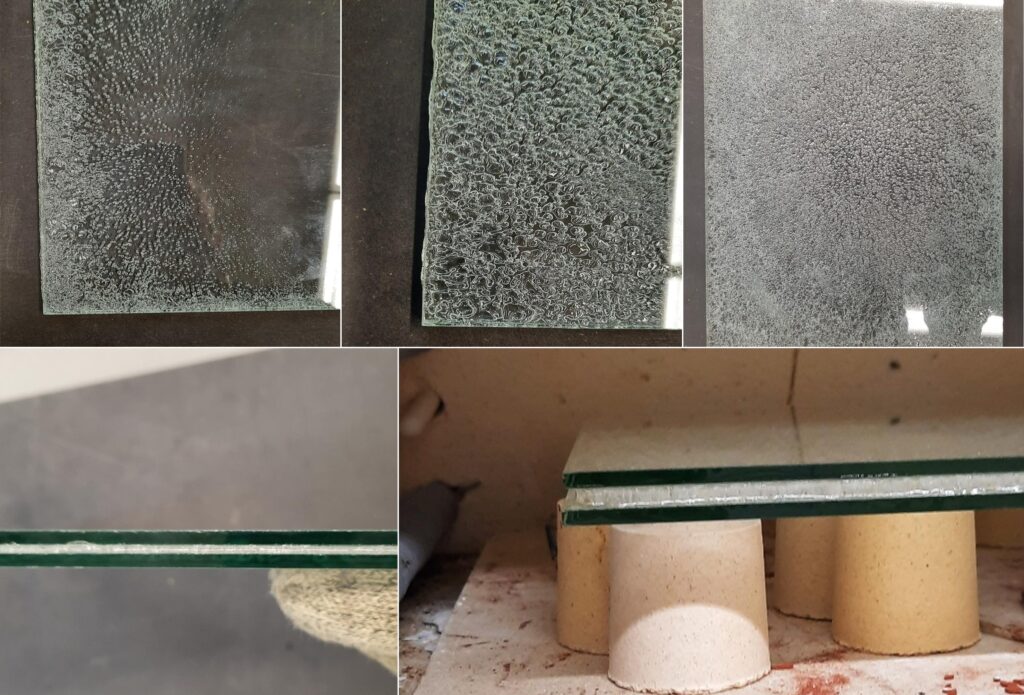
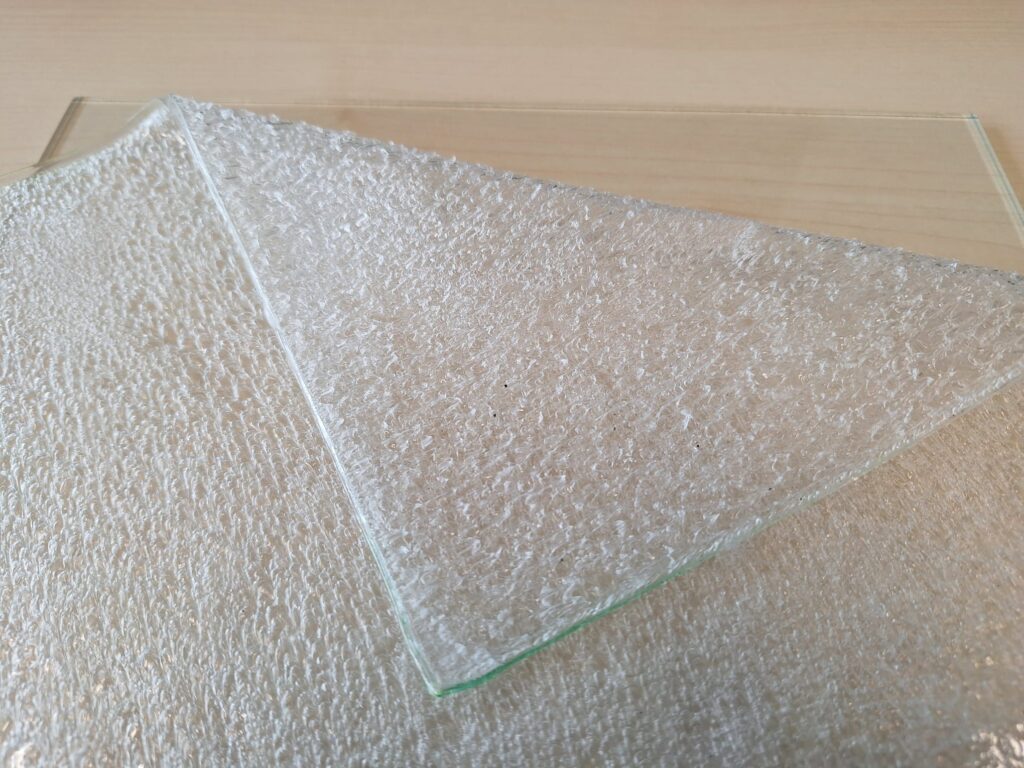
The successful separation of VSG enables closed-loop recycling as cullet in float glass plants and even reuse, for example as glass plates in secondary applications. For a successful, practical and industrial implementation, Schuster sees further steps necessary, such as an in-depth analysis of the daisy effect when heating LSG, industrial scaling of the heating process or automated peeling, optimization of the process parameters and an assessment of the material quality after separation. A corresponding research proposal for further development has already been submitted.
More at glasstec 2026
The glasstec 2026 will once again be the central and stimulating leading trade fair for the exchange on future topics in the glass industry from October 20th to 23rd, 2026 in Düsseldorf (D). With the special show “glass technology live” and the associated “glasstec conference”, the trade fair brings together research, manufacturers and users who want to help shape the future. Visitors can also look forward to a follow-up event on the topic of circularity: “CircuClarity Two”.
Further information: www.glasstec.de
(bt)