Suche
Suche
Concrete processing: Digitalization creates innovation
Digitalization, material innovations and economic pressure are giving concrete processing a breath of fresh air.

Concrete processing: Digitalization creates innovation
Concrete is widely considered to be the most used building material worldwide - little wonder, as the building material is both robust and versatile. However, concrete is also very demanding to process, and work is being done at high speed all over the world to further develop the material. The traditionally purely mechanical discipline is becoming a highly technical area characterized by digital technologies, sustainable innovations and intelligent automation solutions. The industry is faced with the challenge of combining traditional skills with cutting-edge technology while meeting increasing demands for sustainability, efficiency and quality. Companies such as Husqvarna Construction, Tyrolit and Hilti are driving development forward with innovations, while distributors such as Kuhn provide the machines and specialized service providers such as Dima's concrete drilling and sawing service use the solutions on construction sites.
The increasing variety of modern types of concrete - from high-performance concrete to recycled mixtures - increases the demands on tools and machines. Tyrolit responds to this, for example, with tools that are particularly durable and ensure high cutting quality even with extremely hard materials. Another problem area is the health of employees: dust and noise are among the greatest burdens in everyday working life. In recent years, manufacturers such as Husqvarna Construction and Hilti have consistently developed systems that reduce dust through wet cutting or integrated extraction and at the same time reduce noise pollution.
In addition to these technical aspects, economic pressure also remains high. Construction projects have to be implemented in the shortest possible time; downtimes due to tool wear or imprecise cuts are costly for many companies. Low-dust, precise and fast processing methods are now often a decisive selection criterion for clients. Ergonomics is also playing a growing role – devices need to be lighter, easier to handle and have less vibration.
Overcoming traditional approaches
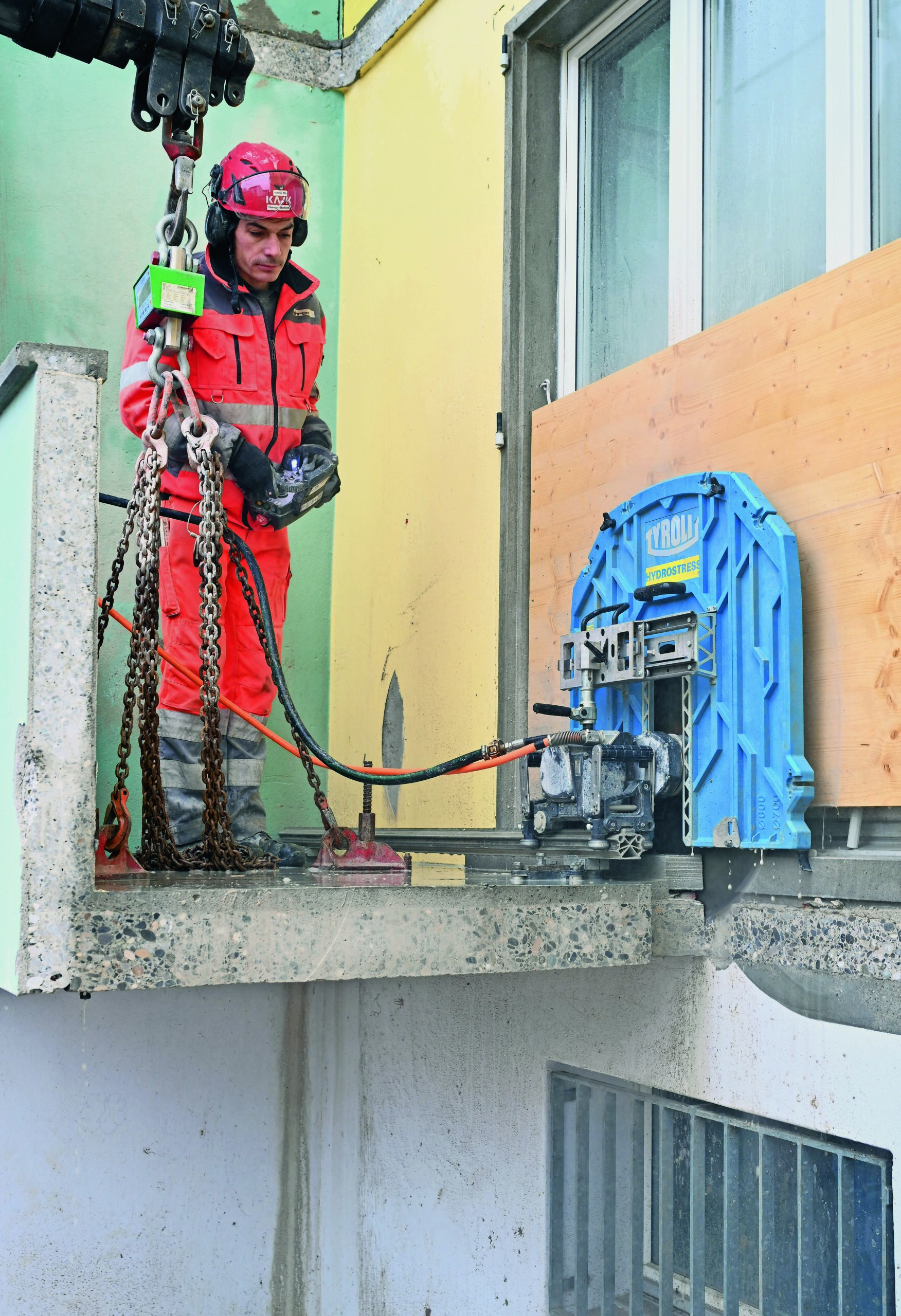
According to industry experts, the application of innovative concepts, such as digital concrete production and process automation, has the potential to massively change the standard technologies for concrete production and bring significant efficiency gains as well as economic and ecological benefits to concrete construction. Building Information Modeling (BIM) has established itself as an important key technology. Through three-dimensional visualization and simulation of concrete processing processes, planners and executors can identify potential challenges and develop solutions in early project phases. The integration of BIM with modern concrete processing machines makes it possible to derive processing parameters directly from the digital models and transfer them to the machines.
There is a visible change in the drives, for example. While gasoline-powered devices have long been dominant, manufacturers such as Hilti and Husqvarna Construction are increasingly relying on battery and electric systems. The advantages are obvious – fewer emissions, lower noise and flexible use even in closed rooms. This development goes hand in hand with greater digitalization of devices. Tyrolit, for example, equips its systems with sensors that monitor wear or cutting quality in real time and thus help reduce failures.
Cloud-based platforms can also be used to enormously improve the monitoring and control of concrete processing projects. Such solutions enable control, production and monitoring in real time – and generally more transparency. Among other things, there are a variety of options for remote monitoring of construction sites, optimization of work processes and preventive maintenance of machines.
AI as a beacon of hope
One field in which development is being driven forward is artificial intelligence (AI). The use of these in concrete processing is still in its early stages, but is already showing promising approaches. AI systems can recognize patterns in large amounts of data that are not obvious to human experts. Predictive maintenance enables predictive maintenance, whereby intelligent algorithms continuously analyze machine data such as vibrations, temperatures and power consumption in order to predict maintenance needs before costly failures occur. This not only reduces downtime, but also optimizes maintenance costs.
Computer vision systems, in turn, can analyze concrete surfaces in real time and detect irregularities or quality defects that would be missed by the human eye. This makes it possible to make corrections immediately and thus ensure uniform processing. Machine learning algorithms that can learn from historical project data and provide recommendations for optimal processing parameters also help. The goal is more efficient work processes and reduced material waste.
The automation of concrete processing is also making massive progress. Modern robot systems are already taking on tasks that were previously carried out exclusively by skilled workers. The development is being accelerated, among other things, by the shortage of skilled workers in the construction industry. Autonomous concrete processing machines can now carry out certain processing tasks independently. GPS control and laser technology enable precise work results and constant quality, especially for repetitive tasks. At the same time, they can work around the clock and are not affected by physical fatigue.

Autonomous robots
Collaborative robots work hand in hand with human operators. These systems take on the difficult, monotonous or health-endangering tasks, while humans take on the creative and problem-solving activities. Advantage: The workload of employees decreases while productivity increases at the same time.
For example, Husqvarna Construction wants to revolutionize concrete processing with the “Autogrinder”. According to the manufacturer, the self-operating floor sander was designed to offer construction companies “unprecedented freedom”. This would allow customers to not only transform every floor, but also “their entire company” and thereby increase productivity and profitability.
"We are very proud to introduce a device that will truly transform the way floor grinding and polishing work is planned and carried out. Husqvarna Autogrinder is a groundbreaking innovation in the concrete processing market," explains Stijn Verherstraeten, Senior Vice President Category & Operations at Husqvarna Construction. Autogrinder 8 D is based on the “PG 8 DR”, a planetary floor grinding machine with Dual Drive Technology. Husqvarna’s “unique navigation system” and safety settings are designed to allow the machine to navigate autonomously during grinding and polishing, allowing operators to focus on other tillage tasks.
"Our field tests and feedback from operators confirm that the Autogrinder represents an important advance. It is clear that we have now ushered in a new era in floor grinding," emphasizes Joakim Leff-Hallstein, Vice President Product Management Surface Preparation at Husqvarna Construction.
Bind more carbon dioxide
In addition, climate change and stricter environmental regulations are forcing the concrete industry to rethink. The aim is to produce the building material as climate-neutrally as possible; organizations such as the Fraunhofer Institute for Building Physics IBP are working on this. According to the researchers, “pyrocharcoal,” for example, is an important key to making concrete more climate-friendly. During production, plant residues or other organic substances such as methane are processed in an oxygen-poor atmosphere. Up to 40 percent of the carbon contained in plants is stored as a solid in the form of pyrochar. Through integration, more carbon dioxide is bound in the concrete than is emitted during production. The researchers have also developed a process to granulate the pyrochar. With the aggregates produced (smaller than two millimeters, editor's note), they replace the sand in the concrete, making the building material not only more climate-friendly, but also significantly lighter. This could in turn save additional transport costs.
In the search for the concrete of the future, it is also worth taking a look at the past - according to Fraunhofer, Roman concrete used in ancient times meets all the criteria for modern, sustainable building materials. They are cement-free, consist of locally available resources such as volcanic ash, are durable and resilient to many external influences. Unfortunately, according to the researchers, the recipes on which they were based were lost. In the Roman Inspired Cement Innovation by Multi-Analytical Enhanced Research (RICIMER) project, experts are researching possible recipes in order to decipher the original formulations, including additives, and transfer them to modern building materials.
Alkaline-activated binders, so-called geopolymers, are another growing field of research. With properties such as corrosion resistance, high strength and excellent temperature resistance, they offer a wide range of possible uses, especially in construction. At Fraunhofer IBP, for example, a process was developed to produce a fully-fledged and, above all, climate-friendly building material from the renewable raw material Typha (cattail), the so-called “Typhaboard”. The versatile insulation and wall building material consists of cattail leaves and a mineral binder, which are pressed into multifunctional panels. Typhaboard combines many properties that make it a productive building material. It is stable, offers good sound insulation, excellent moisture properties, is mold resistant, has a high insulating effect and also offers a high level of fire protection.