Suche
Suche
Real estate in generational change
A look at ownership, sales and future prospects on the Austrian real estate market by Immounited. The differences between generations reveal exciting things.

Real estate in generational change
Studies and surveys show that the Austrian real estate market is changing. Particularly striking: the differences between the generations and their respective housing orientation. According to a broadcast, a generation gap with consequences. While the boomers are selling, their offer is reaching a group of buyers who can't - or don't always want to - buy. Property is still considered a stable investment, but inflation, rising interest rates and the high cost of living are giving interested parties pause.
From Baby Boomers to Gen Z

The Austrian real estate landscape has undergone profound changes in the past decades. While the baby boomer generation often benefited from the economic miracle, rising incomes and comparatively moderate real estate prices, subsequent generations are faced with completely different conditions: entry into property ownership was easier to finance, often possible with one income, and real estate ownership became the standard for retirement provision and securing prosperity. Today, interested parties are faced with record prices, stricter lending guidelines and a high level of uncertainty as to whether the dream of owning their own home is still realistic. Younger generations place more value on flexibility, sustainability and mobility. New models such as co-living or rent-to-own are seen as interesting alternatives.
Shifting a self-image

When Thomas, born in 1958, bought a terraced house on the outskirts of Vienna with his wife in the 1980s, the loan was still affordable on one salary. “We just started building – it was natural to create property,” he says. Today, several decades later, he is thinking about selling it.
His daughter Lisa, born in 1992, lives in a rented apartment in the city. "I earn well, but a condominium in Vienna? Utopian. I would have to be in debt my whole life," she says. For Lisa, her parents' house is not automatically a dream, but rather a responsibility: renovation, energy efficiency, location - all of this costs money. For the parents' generation, property was more attainable and long-term security was the priority. For children's generations, flexibility, mobility and sustainability are more important - property is no longer an end in itself.
Differences in federal state comparison
The current Immounited evaluation as of the end of August 2025 shows: The Austria-wide real estate market is diverse and varies depending on age groups. The decade comparison (2014-2015 to 2024-2025) shows across all generations that Austrians today spend around 51 percent more per square meter on residential properties than they did ten years ago. Interestingly, this particularly affects the age group between 36 and 55, who then and now pay around 17 percent more for their dream property than younger people or silver-agers aged 55 and over.
When purchasing real estate, buyers in the federal state rankings across all generations are happy about low prices per square meter in Burgenland, while Salzburg and Vienna are leaders here. In 2014-2015, people aged 55+ in Burgenland paid a third more for their living space, but in the 2024-2025 period this has shifted to the 36-55 age group. Across Austria, people over 55 years old in Vienna currently pay the most for the price per square meter; the lowest costs are incurred by people up to 35 years old in Burgenland. This result is equivalent to the observation from ten years ago.
On the seller side, Viennese 55+ and Vorarlbergers in the 36-55 age group lead the federal state ranking in terms of prices achieved per square meter and are closely followed by Plus55 Tyroleans, 36-55 year old Viennese and over 55 Salzburgers.
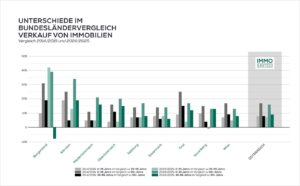
© IMMOunited GmbH
A measure of area
It is interesting to look at how many square meters Austrians in different age groups bought. While Burgenland residents of all age groups have been living on an average of around 78 square meters for ten years, residents from Salzburg have to make do with around 68.5 square meters.
It is striking that the age group of up to 35 years old purchased larger areas ten years ago and that these have decreased by 8 percent across Austria over the years, as larger areas are obviously no longer affordable for this group of buyers. At the same time, people over 55 were buying larger areas again in Burgenland, Carinthia and Vorarlberg.
If you look at the age range in Austria over the past ten years, you can see that in Upper Austria, for example, the younger age groups up to 35 are currently buying the most, while the 55Plus buyers here buy less, but at the same time have more living space.
If you are a Carinthian owner over 55 years old, you are currently enjoying 17 percent more transactions than younger target groups. Followed by 9 percent more property sales to Burgenland buyers over 55 years of age. The trend is reflected in a completely different way in Upper Austria: Here, people aged up to 35 buy twice as much as Silver Liners.

© IMMOunited GmbH
Not a big change in average age
Regarding the average age of property buyers, not much has changed across Austria over the years; the comparison shows a clear line between 41 and 46 years across all federal states. In 2025, on average, the youngest buyers will come from Tyrol at 42 years old, while the oldest buyers at 46 years old will come from Carinthia and Burgenland.
"The upcoming generational change opens up enormous opportunities for the real estate market. What was property for security yesterday will become space for new lifestyles, flexible living models and sustainable concepts tomorrow. We are at the beginning of a phase in which different generations are working together to shape the real estate market of tomorrow," say Roland Schmid, owner & CEO Immounited and Valentin Bauer, Head of Operations Immounited.
Apartment transactions from private purchases/sales from 2014/2015 and 2024/2025 were used for the evaluation. The evaluation was carried out according to the purchase contract date.