Suche
Suche
SHK theory: pressure in the boiler
Finding suitable apprentices in the HVAC industry is becoming a growing challenge for many companies.

SHK theory: pressure in the boiler
In many installation companies, the daily battle for motivated young talent has long been part of the operational reality. Our survey clearly confirms this impression: the vast majority of respondents find it rather difficult or even very difficult to find good apprentices. Only a small minority speak of easy recruitment.
Even if the majority of companies state that they are somewhat satisfied or even very satisfied with their current apprentices, the analysis of the open comments expresses a much more differentiated picture. Deficits in motivation and work ethic, difficulties in communication and fundamental problems in the area of general education are particularly frequently mentioned.
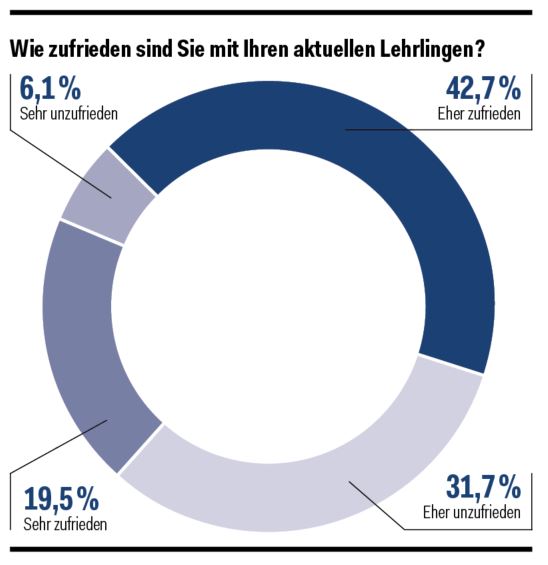 Table 1 ©ÖWV
Lack of attitude
The top challenge among the challenges is the area of motivation and work ethic, with over 66 percent. One company puts it succinctly: "You need young people who are resilient. No one who has to lie down after work because it was so exhausting before." In many places, the expectations of young people no longer seem to be met - which is often attributed to the role of parents. One comment says: “Children are usually not the problem, but the parents who want to give their offspring a carefree start in life - unfortunately the opposite is usually the case.”
Close behind, at 58 percent, was criticism of young people's general education and manners. Arithmetic, writing, knowledge of German – the feedback often mentions massive deficits. One participant says: “The knowledge after middle school is manageable, simple calculations are difficult for many people to solve.”

Weaknesses in the school system
The answers about the attractiveness of teaching in the SHK sector also show that the situation cannot be improved through recruiting measures alone. Although four out of ten respondents still see a strong appeal of the profession - just as many say that interest is decreasing or simply no longer exists. Some voices are particularly critical of society's perception of teaching: "If you ask someone what their children do, you'll hear: Of course they study," says one comment sarcastically. Another says: “The teaching is not particularly well regarded socially.”
This view corresponds to widespread frustration over a lack of recognition – both for apprentices and their trainers. There have been repeated calls for journeymen to be more valued and not demotivated by bureaucracy and cuts.
Criticism of the vocational school
The open answers to the question “What needs to change?” are diverse - but their core message is clear: companies want structural reforms and social rethinking. Among other things, stronger school preparation for the world of work, better language training and lower non-wage labor costs are mentioned.
There is also criticism of the vocational school system itself: “Not as a course, but once a week - so that the apprentices don't lose touch with the company,” suggests one participant. In addition, many companies would like school content to be more closely aligned with everyday working life and not ignore the reality of young people's lives. Some also see the solution in clearer labor law consequences: "The training company should have the opportunity to terminate apprentices who do not complete vocational school. They are taking away apprenticeships from others."
Call for reform
The results of our survey clearly show: SHK apprenticeship training is under pressure. Between social importance, school deficits and a new understanding of values among the young generation, it is becoming increasingly difficult for companies to find suitable young talent - and to retain them in the long term.
But it is also clear that many companies want to get involved, take responsibility and offer young people a real opportunity. However, this not only requires new framework conditions, but also a rethinking at all levels - from the family to school to politics.