Suche
Suche
Night ventilation: New findings for energy-efficient cooling
The “CoolBRICK” research project investigated under real conditions how effectively night ventilation can be used to naturally cool buildings.

Night ventilation: New findings for energy-efficient cooling
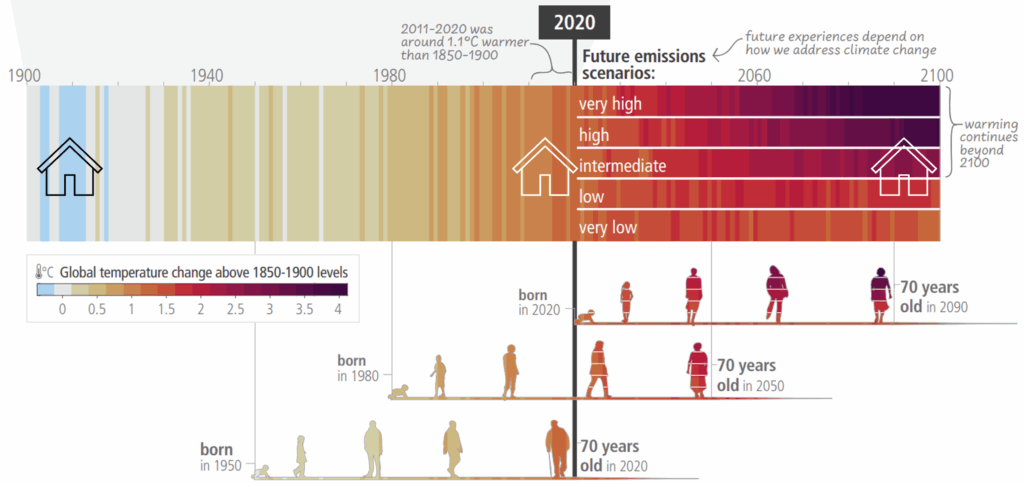
With increasing heat waves and rising temperatures, summer thermal insulation is also becoming a central challenge for the construction industry and building technology. Modern, well-insulated and airtight buildings in particular tend to overheat - especially where there are large window areas and storage capacity. One thing is certain: classic solutions such as air conditioning systems are energy-intensive and not in the spirit of sustainable construction. Natural night ventilation offers an energy-efficient and cost-effective alternative - if it is planned and controlled in a targeted manner.
Aim of the CoolBRICK project
The CoolBRICK research project investigated for the first time under real conditions how different ventilation scenarios work at night - especially in combination with brick masonry as a storage mass. The focus is on the effect of different window positions, control technologies and forms of ventilation on the cooling of buildings at night.
The project was carried out by well-known partners such as the Association of Austrian Brick Works (VÖZ), the ZAB Zukunftsagentur Bau, the University of Krems, the Salzburg University of Applied Sciences and Velux Austria.

Investigation under real conditions
The heart of the research project were two identical test houses with brick walls and external blinds on the windows on the BAUAkademie Salzburg site(see cover photo). These were monitored for years with more than 200 sensors to record the actual cooling potential of various night ventilation scenarios. In addition, different control technologies and window opening positions - from the classic tilt position to automated cross ventilation and using mathematical models - were tested. The results are groundbreaking: “For the first time, the project provides comprehensive, empirical data on how natural night ventilation and targeted cooling of the storage masses can be used most effectively,” explains Heinz Hackl, Public Affairs Manager at Velux Austria. "Even simple measures such as targeted cross ventilation have an enormous effect. The potential of this low-tech method has previously been underestimated in many cases."
Essential insights for construction practice
1. Tilt windows are not enough
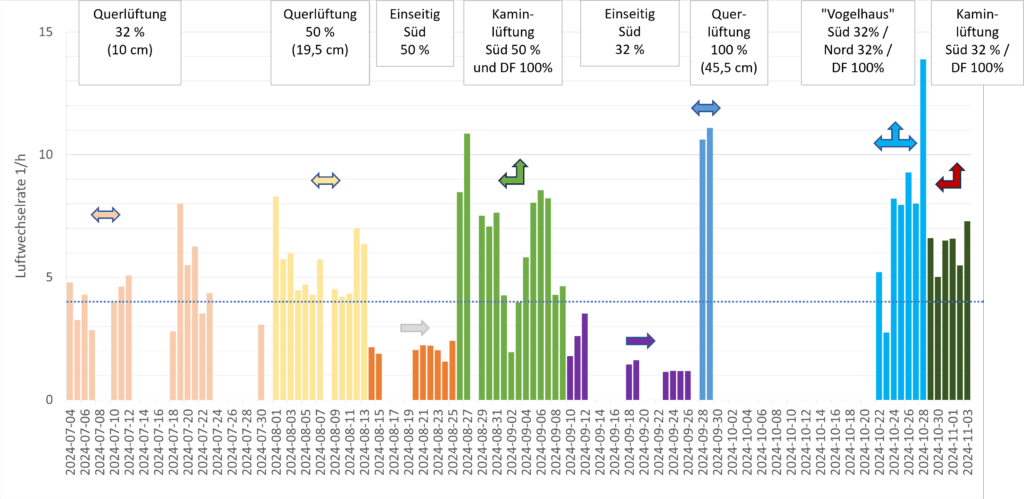
The classic tilted window position ensures hygienic air exchange, but only reduces the room temperature by approx. 1.6°C - with a maximum air exchange rate of 2 h⁻¹. In modern, well-insulated buildings, this is often not enough to avoid overheating in summer.
2. Cross ventilation has a significantly greater effect
If ventilation is carried out on two opposite sides (e.g. facade + back or facade + roof), air exchange rates of over 4 h⁻¹ result with a window opening of only 20cm. The room temperature could be reduced by up to 5.5 °C - a clearly noticeable effect on living and working comfort.
3. Chimney ventilation is particularly effective
The combination of open roof and facade windows creates a so-called “chimney effect”: warm air rises and escapes through the roof, while cooler night air flows in below. Result: Air exchange rates of up to 12 h⁻¹ – even with hardly any measurable outside air movement (< 0.5m/s).
4. Brick walls support natural cooling
Due to their high thermal mass, brick walls can store the heat of the day and release it again at night via ventilation. This passive discharging of the storage masses is only effective if enough cold air circulates - i.e. with well-planned night ventilation.
5. Automated control increases efficiency
Simply opening the window is not enough – the right timing is crucial. Intelligent, sensor- or model-based controls open and close windows proactively and taking weather data, wall temperature and indoor climate into account. This enables maximum cooling effect with minimal energy use - also ideal for the use of roof windows with automatic control.
Importance for construction practice and sustainable building planning
The results of the study underline how important well-thought-out ventilation concepts are for new construction and renovation of buildings:
Planning roof windows
- Der Einsatz von automatisierten Dachfenstern (z. B. Velux „Integra“) kann gezielt zur Kaminlüftung beitragen.
- Fensterpositionierung wird zur entscheidenden Planungsfrage: Ideal sind Durchlüftungsachsen über Fassaden- und Dachöffnungen hinweg.
- In der Sanierung lohnt es sich, zusätzliche Öffnungsflächen nachzurüsten – insbesondere in schwer durchlüftbaren Dachgeschossen.
Integration into the ventilation concept
- Nachtlüftung sollte als Teil eines ganzheitlichen Lüftungs- und Klimakonzepts verstanden werden – auch ohne mechanische Lüftungsanlagen.
- Low-Tech-Lösungen wie natürliche Lüftung können durch smarte Steuerungen ein neues Maß an Effizienz erreichen.
Contribution to sustainability and energy efficiency
- Reduktion von Überhitzung ohne aktive Kühlung sorgt für geringere Betriebskosten, zusätzliche Kühlsysteme sind nicht nötig.
- Wichtiger Beitrag zur Erreichung von Klimazielen und Reduktion des Energiebedarfs im Sommer.
Förderfähigkeit möglich im Rahmen nachhaltiger Bau- und Sanierungsvorhaben.
Conclusion: Plan night ventilation specifically - instead of just tilting windows
The CoolBRICK project impressively shows that with well-thought-out ventilation planning, targeted window arrangement and automated control, the room temperature can be significantly reduced at night - without any technical cooling. The roof in particular plays a crucial role here due to the chimney effect. This makes intelligent roof window solutions a central component for climate-resilient, healthy and energy-efficient buildings.
(bt)